The work plan and GTD
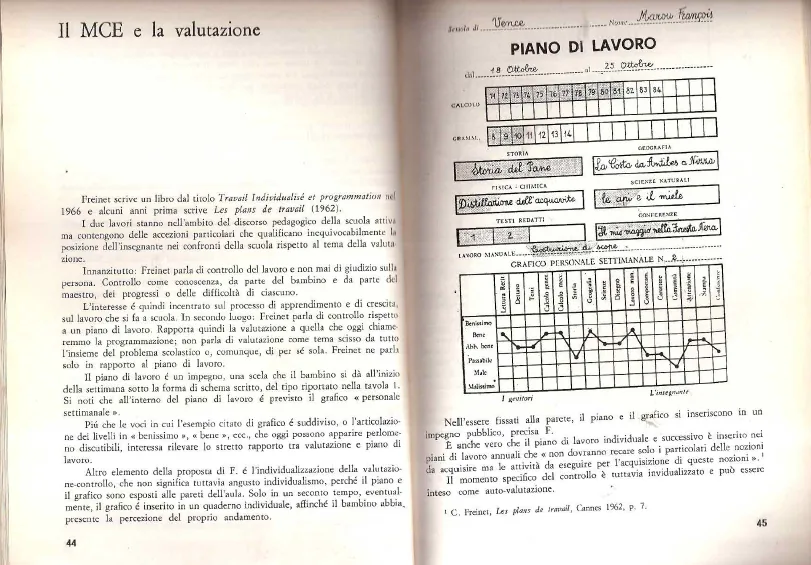
The work plan is a Freinet technique developed to individualise learning without separating the learner from the cooperative life of the class. Each pupil works on goals and activities suited to their needs, while remaining connected to shared purposes, tools and projects.
It is not a different list of tasks handed down to each learner. Learners gradually help identify goals, choose activities, organise time, record work and assess themselves. The Movimento di Cooperazione Educativa therefore presents it as taking responsibility: autonomy and choice are supported by clear commitments to oneself and the community.
A plan may combine practice, self-correcting materials, paired activities, tutoring, free writing, reading, research, art and responsibilities within collective projects. Individualisation means neither isolation nor remedial work alone: different approaches and rhythms can also accommodate interests and creativity.
How it can work
- Recognise goals: make shared goals explicit and identify personal ones through discussion and observation.
- Choose tools and activities: offer varied, understandable and accessible options linked to goals.
- Organise work: agree on time, priorities and individual, paired or small-group arrangements.
- Record and share: leave a trace of activities and take responsibility for explaining the work.
- Self-assess and redesign: review progress with the teacher and define the next step.
The teacher prepares the environment and materials, makes connections between goals and tools visible, supports metacognitive dialogue and uses independent work time for targeted support. Autonomy develops gradually: the plan must suit learners’ ages, the class’s experience and its actual conditions.
Connecting with GTD
David Allen’s Getting Things Done® (GTD) organises personal commitments through five steps: capture what has your attention, clarify its meaning and next action, organise reminders and materials, reflect regularly and engage. It did not originate as a teaching method, but can offer useful tools particularly in upper secondary education, Italian ITS technical academies and universities, where projects and deadlines multiply.
The two should not be confused. The work plan belongs to a cooperative pedagogy linking individual learning with class life; GTD is a personal system for managing commitments. Their combination can support autonomy and metacognition, provided organisation does not become an end in itself or make individuals responsible for unsustainable educational conditions.
Sources
Reference titles are retained in their original language. Linked resources may be in Italian or another language.